Use the buttons below to access the databases with Chrome, Firefox, or Microsoft Edge:
- The Avian Conservation Assessment Database provides conservation assessment data and rankings for all North American bird species at multiple geographic scales.
- The Population Estimates Database provides estimates of breeding population size at multiple scales for U.S. and Canadian landbirds only.
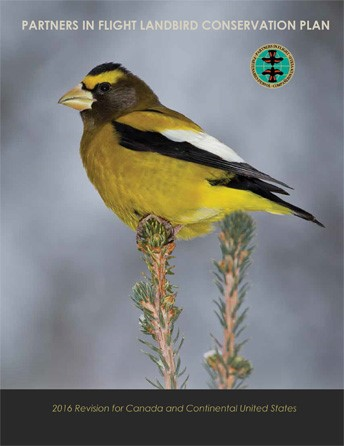
The PIF Databases were developed with the input of dozens of ornithological experts from 10 countries. They are managed by Bird Conservancy of the Rockies and form the scientific basis for the 2016 PIF Landbird Conservation Plan, other bird conservation plans, and State of the Birds Reports.
| Database News: |
|---|
| February 27, 2024: Changes to the Global ACAD are summarized here while the handbook is in the process of being updated. December 20, 2023: The Global ACAD has been updated! The latest updates include: (1) Climate vulnerability assessment scores (CV-b, CV-n) were added for 604 species in the downloadable file, and incorporated into updated continental threats scores (TB-c/TN-c) (2) Population trend (PT) assessment criteria, data and scores were updated for 495 species with BBS data through 2021 and through 2019 for other surveys (3) The criteria for assessing population trend (PT) were revised to incorporate consideration of both short-term (most recent 3-generations or 10 years) and long-term trends (since 1970, generally), which are both available in the downloadable file (4) Half-life estimates were updated using short-term trend data and limited to PIF Watch List and Common Birds in Steep Decline species with half-lives of 30 years or less (5) The PIF Watch List categories were updated to align with the latest Road to Recovery (R2R) Tipping Point list and categories, which are now incorporated into the Watch List categories (6) Common Bird in Steep Decline is now based on either PT-c = 5 OR a long-term 50% population loss (7) Taxonomy was updated to the 63rd Supplement to the AOS Check-list of North American Birds (8) Migratory Status was updated to follow eBird Status and Trends classification, reclassifying all partial migrants (PM) as migrants (M), (9) The global and US/Canada population estimates for Ivory Gull were updated using the most recent data available from Canadian Wildlife Service (COSEWIC). The Regional ACAD and Handbook will be updated soon – check back for updates. February 23, 2021: The Global ACAD has been updated for 2021! The latest updates include: Streamlined and standardized geography and habitat classification for all species from Canada to Panama. Added “Urban” (breeding season only; not yet comprehensive south of USA) and “Agriculture” designations subject to further review. The Regional ACAD has also been updated! We’ve merged the Central American, Mexican and US/Canada databases together; now all are accessible through a single user interface. We’ve merged some of the Mexican species assessment regions, including along the U.S.-Mexico border into the BCRs that span both sides of the border, to align better with eBird STEM model regions to facilitate incorporating abundance data from these analyses into the PIF assessment process. We’ve temporarily removed a few pelagic species that were never scored during the Mexican Regional Assessment in the former Mexican regions ISRE (Islas Revillagigedo, now merged into BCR33) and CEPL (Central Pacific Lowlands, now merged into SCPL, Southcentral Pacific Lowlands). We hope to provide full assessment for these species soon. We also removed non-breeding-only birds in Central American regions from the Regional ACAD until non-breeding scores are added for all regions. We’ve also added dates when scores were last reviewed for Mexican and Central American regions. Further details on these updates can be found in Appendix C of the ACAD handbook. September 4, 2020: The Avian Conservation Assessment Database and Population Estimates websites are being rebuilt to improve ease of use and functionality. The 2020 data is available: ACAD Global Assessments (2020-04-28) ACAD US/Canada Assessments (2020-06-03) ACAD Mexico/Central America Assessments (2020-04-28) PED Continental/Global Estimates (2020-04-29) PED Estimates by BCR (2020-04-24) PED Estimates by Province/State (2020-04-24) PED Estimates by BCR and Province/State (2020-04-24) Current versions of the Avian Conservation Assessment Database and Population Handbooks are available: Avian Conservation Assessment Database Handbook (2020) Population Estimates Handbook (2020) Version 3.1 of the Population Estimates Database Handbook incorporates minor improvements in text clarity over the previous 3.0 version, updates citations in the Literature Cited, and documents changes in sources for a few species. The content of the Population Estimates Database itself remains the same except for changes to the estimates for Black Vulture at all scales (see p. 14); the estimates for California Scrub-Jay and Woodhouse’s Scrub-Jay at all scales (p. 14); revised Time of Day adjustments and population estimates at all scales for Mexican Whip-poor-will and Long-eared, Elf, Flammulated, Western Screech, Great Gray, and Northern Hawk owls; the global and USA/Canada estimates for Dusky Grouse, Snowy Owl, and Peregrine Falcon; the global estimates and percent of global estimate in USA/Canada for Black-billed Cuckoo, Belted Kingfisher, Willow Flycatcher, Red-eyed Vireo, Bluethroat, Golden-winged Warbler, American Redstart, and Indigo Bunting; and updated taxonomic sequence and name changes corresponding to the 60th supplement to the AOS Check-list of North American Birds (Chesser et al. 2019). Version 2020 of the ACAD was also updated taxonomically to the 60th supplement, and extinct and extirpated species removed. The Mig Status field was corrected. This version also includes many changes to PS-g and PT-c and associated fields (including restoring the Pop Change field and adding a PopYr field) based on incorporation of many of the data sources used in Rosenberg et al. 2019 (Science). At the regional level, a small number of northern breeders were changed from PT-r = 3 for unknown trend to a more informative score based on expanded BBS. The Intro to BCR field was dropped due to inconsistencies. The field %WH_UsCa was added, and the complementary field %Breeding Pop in US & Canada was corrected and in some cases nulled where previous percentages appeared questionable. TB-r scores based on TB-c were updated to reflect changes to TB-c. TB-r was copied into TN-r for residents of Guatemala and Costa Rica missing TN-r. The action code PR was corrected. Truncated and missing comments were restored and erroneous comments deleted. The ACAD Handbook Version 2020 was updated to reflect these changes. March 5, 2019: The Avian Conservation Assessment Database (ACAD) has been completely updated in 2019 to include assessment data for 1604 breeding species found from Canada to Panama, including waterfowl, shorebirds, waterbirds and landbirds, based on the latest data on population size, trend, distribution and threats, as well as regional assessments for all breeding birds in all U.S. and Canadian BCRs. Regional assessments for Mexico and Central America are currently available via download only from the ACAD homepage.The Landbird Population Estimates Database (PED) has been updated in 2019 to include the latest population size estimates for 453 landbirds in the U.S. and Canada, including measures of uncertainty as estimated by Stanton et al. 2019. View or download estimates at continental, BCR, and State/Provincial scales. Estimates for BCR x state/province polygons are now available only via download from the PED homepage. May 2017: The PIF Species Assessment Database, now called the Avian Conservation Assessment Database, has been updated – and expanded! The ACAD (for short) includes all regularly-occurring bird species found in North America and adjacent waters from Canada to Panama, including approximately 1600 species of waterbirds, shorebirds, waterfowl and landbirds. Currently, only the Global ACAD is available while the Regional ACAD undergoes a similar update, expansion and review. For now, the 2012 version of the Regional Species Assessment Database for landbirds remains available, but we caution that this database contains information that has now been updated in the Global ACAD. We expect the Regional ACAD to be completed by the end of 2017, at which time it will be posted on this site. The expansion of the ACAD to include all avian taxa in continental North America was made possible through the work and collaboration of various groups in addition to PIF, including the U.S. Shorebird Conservation Partnership, the Migratory Bird Joint Ventures, and dozens of ornithologists from across North America who helped populate and review the contents of the database. We welcome additional feedback from other groups and individuals to improve upon the information in this first version of the ACAD. Please contact us if you find any errors or omissions. We expect to update the Global ACAD within 1-2 years with additional input received. 13 June 2013: New landing page for both databases published. Avian Conservation Assessment Database address changed from pif.rmbo.org and redirected to new landing page. April/May 2013: Reviewed, edited and incorporated landbird population estimates and related data into the PIF Population Estimates database. New Population Estimates database dissemination website designed and published. Population estimates in Avian Conservation Assessment database harmonized with updated numbers in Population Estimates database. |
 | Become a Partner in Flight! Support the PIF databases! |  |