

Chihuahuan Grasslands
Grassland birds have declined more than any other group of North American birds.
The causes for most of the declines are poorly understood but likely stem from changes in the quantity and quality of grasslands across their migratory range.
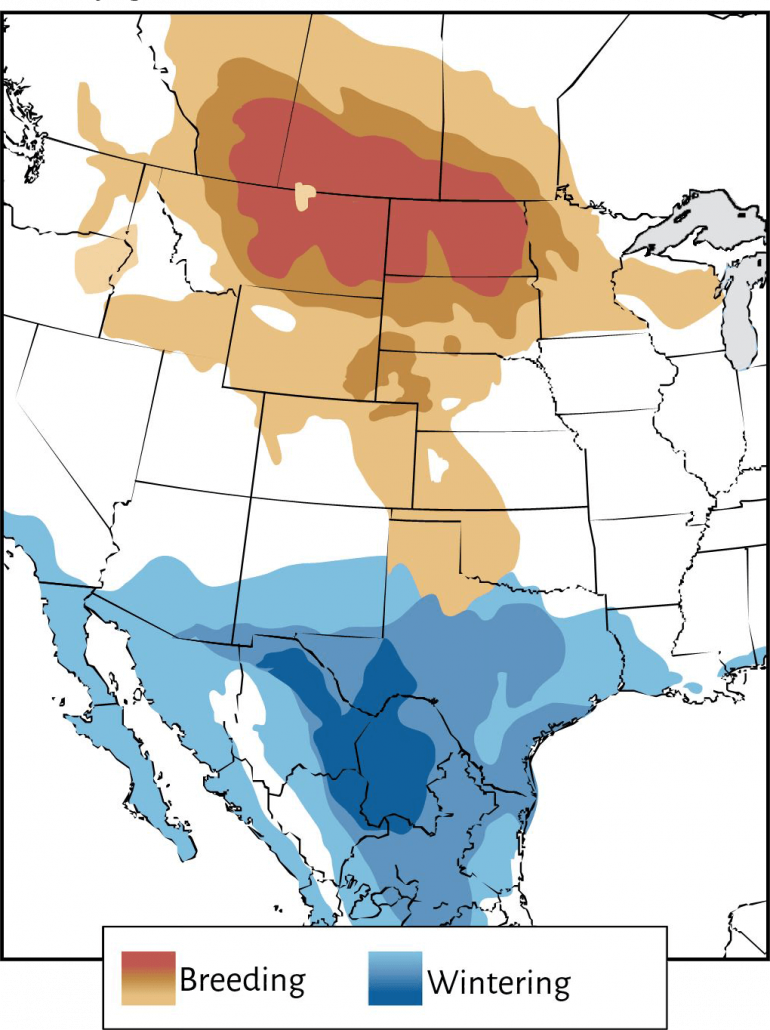
Many grassland birds utilize the Great Plains and Chihuahuan Desert region throughout their annual cycle
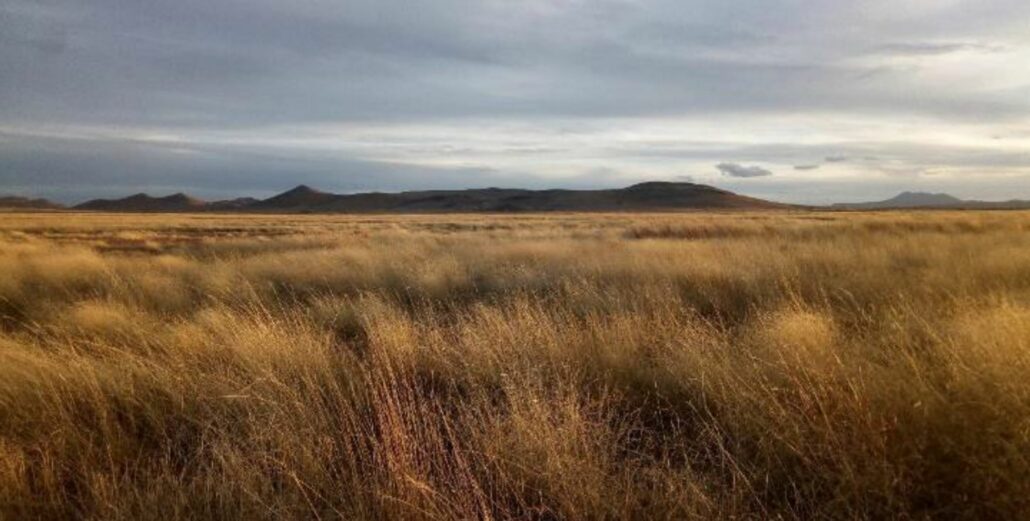 Unfortunately, the loss of desert grasslands is accelerating, especially in Mexico where the expansion of center-pivot irrigated agriculture has converted more than 100,000 acres in Chihuahua alone since 2005. This recent surge in land conversion is threatening to extirpate the last desert-dwelling Aplomado Falcons and the Mexican Pronghorn, while severely impacting other grassland species.
Bird Conservancy of the Rockies, alongside our partners in Mexico and the U.S., is working conserve Chihuahuan Desert grasslands and the birds that depend on them. Until recently, little was known about how grassland birds are distributed among the grasslands of the region and what affects their abundance and survival. Bird Conservancy is leading the way to fill these critical information gaps, while developing a platform for broader conservation. We are producing the scientific knowledge and tools needed to advance strategic habitat conservation, while building international partnerships, local capacity and public support for grassland conservation throughout the region.
Unfortunately, the loss of desert grasslands is accelerating, especially in Mexico where the expansion of center-pivot irrigated agriculture has converted more than 100,000 acres in Chihuahua alone since 2005. This recent surge in land conversion is threatening to extirpate the last desert-dwelling Aplomado Falcons and the Mexican Pronghorn, while severely impacting other grassland species.
Bird Conservancy of the Rockies, alongside our partners in Mexico and the U.S., is working conserve Chihuahuan Desert grasslands and the birds that depend on them. Until recently, little was known about how grassland birds are distributed among the grasslands of the region and what affects their abundance and survival. Bird Conservancy is leading the way to fill these critical information gaps, while developing a platform for broader conservation. We are producing the scientific knowledge and tools needed to advance strategic habitat conservation, while building international partnerships, local capacity and public support for grassland conservation throughout the region.
Wintering Grassland Bird Surveys
Since 2007, Bird Conservancy has led a bi-national effort to inventory and monitor wintering grassland bird populations in the most important grasslands in the Chihuahuan Desert. This project produced, for the first time, rigorous information on the distribution, density and habitat use of nearly 30 grassland species throughout most of the desert. We used this information to redraw the map of priority conservation sites and develop conservation tools for this region. We also developed a bi-national network and partnership of organizations with increased capacity to address grassland bird conservation.
.
Winter Grassland Bird Survival Research
Bird Conservancy began a pilot investigation in 2009 into the winter survival and daily movements of grassland birds to better understand if populations are limited during the winter and what factors affect their survival.
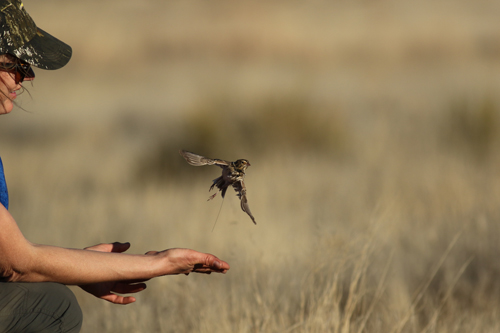
We focused our initial efforts on Vesper Sparrows, using radio-telemetry, and in the winter of 2012-2013 extended this research to Grasshopper and Baird’s Sparrows. Results from the Vesper Sparrow study suggest grass height has a strong effect on survival, with at least 30 cm of standing cover needed to provide effective protection from predators. This need for tall standing cover is also desired by many range managers, highlighting the great compatibility of bird conservation and range management objectives in the Chihuahuan grasslands.
Read more about our winter grassland bird survival research on our blog.
Education and Outreach
Bird Conservancy has developed education and outreach tools for people living and working in grasslands. Our Guia de Bolsillo para Aves de Pastizal del Desierto Chihuahuense (Pocket Guide to Chihuahuan Desert Grassland Birds) has successfully engaged landowners and increased their awareness about birds. Our manual “Compartiendo Sus Agostaderos con Las Aves de Pastizal” (Sharing Your Rangelands with Grassland Birds) provides best management practices to help landowners and range managers understand bird conservation needs and incorporate bird-friendly practices into their management and extension services. We also produced a video, with support from Habitat Seven, Cornell Lab of Ornithology and others, to engage ranchers in northern Mexico in conservation efforts and highlight options for them to enhance production.
Habitat Enhancement
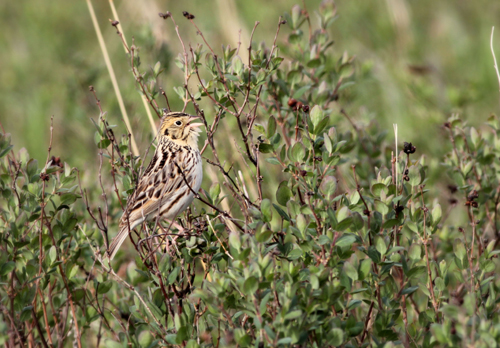
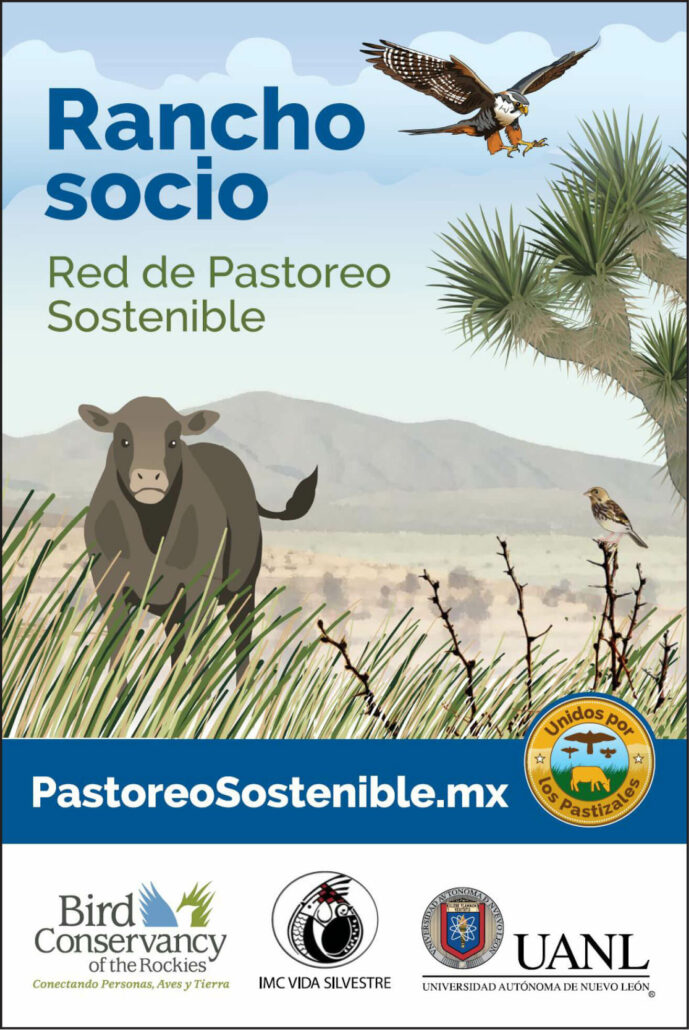
Bird Conservancy partners with private landowners in Mexico and the U.S. to implement habitat improvement efforts for grassland birds. The “Sustainable Grazing Network” in Mexico engages cattle ranchers and other producers that support a mosaic of grassland conditions to benefit a range of priority species with differing habitat needs. Through rotational grazing, invasive shrub removal, prescribed grazing and other techniques, we are restoring habitat conditions needed in winter by species such as Sprague’s Pipit, Chestnut-collared Longspur and Baird’s Sparrow, while reducing sources of mortality and other limiting factors on private ranches and ejidos through simple conservation efforts. By working with ranchers, we can keep working ranches viable and increase the carrying capacity of the land to support more birds.

Removing encroaching shrubs from the landscape to restore grassland habitat
.
Next Steps
Our grassland bird demographic research has expanded to include survival and productivity on the breeding grounds of the Northern Great Plains. We are also monitoring birds on the connected Chihuahuan desert grasslands of the Trans-Pecos in western Texas. Recent advances in tracking technology bring us closer to filling in knowledge gaps for grassland birds. Bird Conservancy is spearheading the development of a collaborative network of automated radio telemetry stations in the GPCD region as part of a world-wide network, the Motus Wildlife Tracking System. With a number of university and nonprofit partners in Mexico and funding from the Neotropical Migratory Bird Conservation Act, station installations are planned for northern Mexico to track birds once they arrive to the Chihuahuan Desert grasslands.
Related Reports & Publications
Winter Monitoring of Grassland Birds in the Chihuahuan Desert
Aplomado Falcon (Falco femoralis septentrionalis) Monitoring in Valles Centrales, Chihuahua, Mexico
Remote sensing of shrub habitats in Janos GPCA, Mexico
Chihuahuan Desert Wintering Grassland Birds Report
Chihuahuan Desert Wintering Grassland Birds (Technical Report)
Chihuahuan Desert Wintering Grasslands Bird Survival Phase II (Annual Report)
View more reports on Bird Conservancy’s Reports page.
Conservation Plans
Action Plan for Chihuahuan Desert Grasslands
Chihuahuan Desert Master Plan
Chihuahuan Desert Grassland Bird Conservation Plan
Partners
Bird Conservancy thanks its partners that have helped implement these projects; in the U.S., the Bureau of Land Management in New Mexico has been an important partner, and special thanks to our international partners in Mexico, including the Universidad Autónoma de Nuevo Leon, Universidad Juarez del Estado de Durango, Universidad Estatal de Sonora, IMC-Vida Silvestre, A.C., The Nature Conservancy, World Wildlife Fund-Mexico, Profauna-Coahuila, A.C., Profauna-Chihuahua A.C., Pronatura Noreste A.C., Pronatura Noroeste A.C., Universidad Nacional Autónoma de Mexico, Borderlands Research Institute at Sul Ross State University (SRSU) CONANP, CONABIO, Cuenca Los Ojos Foundation and numerous private and communal landowners .
Financial Support
Major funding for these programs has come from the Neotropical Migratory Bird Conservation Act, U.S.D.A. Forest Service International Program, National Fish and Wildlife Foundation, The Nature Conservancy, Commission for Environmental Cooperation, Rio Grande Joint Venture, American Bird Conservancy, Rio Grande Research Center, National Park Service, Texas Parks and Wildlife Department, Rio Grande Joint Venture, Sonoran Joint Venture, Colorado Parks and Wildlife, Colorado State Land Board, Arizona Game and Fish Dept., New Mexico Dept. of Game and Fish, The Association of Fish and Wildlife Agencies – Southern Wings Program and the City of Fort Collins, Colorado.
For more information:
Arvind Panjabi
Senior Research Scientist
(970) 482-1707 x 20